A real solar system repair case study from Kitale, Trans-Nzoia County, Kenya
A solar system can operate reliably for years. However, one incorrect connection, an unsuitable electrical load, or inadequate protection can turn a functioning installation into a major repair project within minutes.
In April 2026, Aretha Solar Power Solutions received an urgent call concerning a solar installation in Kitale, Trans-Nzoia County.
The call came from a client based in the United States. Her parents were living in Kitale, and their solar system had suddenly stopped working.
The house was dark.
The inverter was no longer producing power.
At first, the family did not know what had happened.
When we investigated the installation, however, we found a much bigger problem. An angle grinder had been connected to the solar system’s AC output. The incident severely damaged the inverter, and the resulting electrical problem also affected appliances and left the battery bank in poor condition.
What followed was a complete diagnostic exercise, individual battery testing, replacement of the damaged inverter, replacement of the battery bank and a major upgrade to the system’s electrical protection.
This case study explains what happened, what we found, why the batteries could not simply be reused, and what solar system owners in Kenya can learn from the incident.
If you own a solar system in Kitale, Eldoret, Nairobi, Nakuru or anywhere else in Kenya, this is the kind of problem you want to prevent rather than repair.
What Happened to the Solar System in Kitale?

The problem began when an angle grinder was plugged into an AC outlet supplied by the solar inverter.
An angle grinder is not an ordinary household load.
It contains a motor that draws a significant amount of current when starting. Motors also behave differently from simple resistive loads such as incandescent lamps or heaters.
When a motor starts, stops or experiences a stall condition, its electrical characteristics can create significant transients and disturbances. A solar inverter must be designed and protected to handle the loads connected to it.
In this particular installation, something went seriously wrong.
The inverter subsequently failed.
The family did not immediately know that the inverter had been damaged. When they later switched the house back to the solar supply, the system produced abnormal voltage.
Several light bulbs failed.
The refrigerator’s voltage guard also burned.
At that point, the solar system was no longer simply experiencing a low-battery or inverter fault. It had become a significant electrical safety and equipment-damage issue.
That is why diagnosing a failed solar inverter requires more than simply switching the equipment on and seeing whether it works.
A proper investigation has to establish:
- What caused the failure?
- Which components survived?
- Which components were damaged?
- Are the batteries still usable?
- Are the solar panels still producing correctly?
- Is the wiring safe?
- Are the protection devices functioning?
- Can the existing equipment be safely recommissioned?
- What needs to be replaced or upgraded in this solar system repair in Kenya?
That was the approach we took in Kitale.
Why an Angle Grinder Can be Dangerous for a Solar Inverter
An angle grinder contains an electric motor.
Unlike a simple resistive load, a motor has inductive characteristics. It can also demand a high starting current compared with its normal running consumption.
This matters because an inverter has limits.
A hybrid or off-grid inverter is an electronic power-conversion device. It takes DC energy from batteries and/or solar equipment and converts it into AC power for household loads.
The inverter’s output is controlled electronically.
When a motor load starts, stops, stalls or behaves abnormally, the electrical system can experience a transient event. Depending on the inverter design, protection, wiring arrangement and exact fault conditions, this can result in an overload, fault, voltage disturbance or damage to internal electronic components.
Therefore, it is dangerous to assume that every appliance that can physically fit into an AC socket is automatically suitable for a particular solar installation.
Large motors, compressors, welders, pumps and power tools need to be considered during solar system design.
The correct question is not simply:
“Can the inverter run this appliance?”
The better question is:
“Can this inverter safely and reliably handle this appliance’s starting characteristics, running load and electrical behaviour together with the rest of the system?”
That distinction is extremely important.
The First Lesson: Never Assume an AC Socket is Suitable for Every Load
A solar installation should be treated as an engineered electrical system, not simply as an alternative wall socket.
If an inverter supplies the house, every connected appliance becomes part of the electrical load profile.
Some loads are easy for an inverter to handle.
Others require more careful consideration.
Examples include:
- Angle grinders
- Arc welders
- Large water pumps
- Compressors
- Heavy-duty power tools
- Large refrigeration systems
- Electric motors
- Workshop machinery
Some may require significant starting power. Others may create electrical disturbances that an inadequately protected system cannot tolerate.
This does not mean that every solar inverter can never operate a motor load.
It means the inverter must be properly selected and the installation must be designed around the actual loads.
That includes checking the inverter’s:
- Continuous power rating
- Surge capacity
- Output characteristics
- Protection functions
- Battery voltage
- Cable sizing
- Circuit protection
- Earthing arrangement
- Generator/grid integration where applicable
The lesson from the Kitale installation is simple:
Do not connect high-starting-current machinery to a solar system without confirming that the system was designed to handle it.
What we Found When we Inspected the Kitale Solar System
Once we arrived on site, we did not immediately replace components.
First, we carried out a structured inspection and electrical testing.
The first good news came from the solar array.
The photovoltaic panels had survived.
The MPPT controller was reading approximately 127 volts on the PV input, with charging current around 20 amps and approximately 2 kW of solar generation during testing.
That meant the solar array was still capable of producing energy.
However, the inverter was a different story.
The inverter was dead.
It was producing no usable AC output and could not be returned to normal operation through standard troubleshooting.
Based on the condition of the equipment and the damage observed during diagnosis, replacement was the appropriate solution.
But the inverter was not the only problem.
The batteries required much more investigation.
Testing all 16 Solar Batteries Individually
The installation contained 16 gel batteries.
It would have been easy to assume that the batteries were fine because the system failure had initially been associated with the inverter.
That would have been a serious mistake.
We tested the batteries individually.
After allowing them to rest for approximately 30 minutes, we measured their individual open-circuit voltages.
The results revealed substantial damage.
Five batteries were below 10 volts.
Two of those batteries measured approximately 6.2 volts.
That is an extremely concerning reading for a nominal 12-volt battery.
The remaining 11 batteries were also deeply discharged, with readings approximately between 10.5 and 11.5 volts.
This showed that the battery bank had suffered far more than a temporary loss of charge.
The measurements gave us evidence that individual batteries had experienced severe and prolonged discharge.
One battery measured approximately 6.2 volts.
That battery could not simply be put back into service and expected to perform normally.
Why Individual Battery Testing Matters in This Solar System Repair
When a solar installation contains multiple batteries, testing only the total bank voltage can hide serious problems.
For example, a bank might show an apparently reasonable combined voltage while one or more individual batteries are severely degraded.
Individual testing can reveal:
- A battery with an abnormally low voltage
- A weak battery
- A battery with poor capacity
- Uneven charging
- Imbalance between parallel strings
- Evidence of prolonged deep discharge
This is why solar battery maintenance should not consist of looking at the inverter display alone.
The inverter can tell you what the system is doing.
It cannot necessarily tell you the health of every individual battery.
What is Battery Back-feeding?
The 16 batteries were arranged in two parallel strings.
The problem was that several batteries in one string had become severely damaged.
When batteries are connected in parallel, current can flow between connected batteries under certain conditions. A weak or failed battery can therefore affect the behaviour of the rest of the battery bank.
In this installation, the damaged batteries were not simply sitting disconnected from the rest of the system.
They contributed to an unhealthy battery-bank condition that caused additional discharge of the remaining batteries.
This is one reason why replacing only the visibly failed batteries in a heavily aged or damaged battery bank can be a poor strategy.
Imagine installing five new batteries beside eleven severely degraded batteries.
The new batteries would immediately become part of the same electrical system.
They would not magically restore the health of the remaining old batteries.
Depending on the battery chemistry and configuration, differences in internal resistance, state of charge, capacity and age can create imbalance and reduce overall system performance.
That is why we recommended replacing the complete battery bank rather than mixing severely damaged batteries with new replacements.
The client accepted the recommendation.
Why we Replaced all 16 Batteries Instead of Only 5
This was one of the most important decisions in the project.
The obvious question was:
“If five batteries are dead, why not replace only those five?”
Because the other batteries had also suffered.
The remaining 11 batteries were deeply discharged, with measured voltages around 10.5–11.5 volts after the system had been left in a failed condition.
That does not automatically prove that every one of those batteries was irreversibly damaged. However, the combination of:
- prolonged discharge,
- severely failed batteries in the parallel bank,
- uneven battery condition,
- the age and configuration of the bank, and
- the risk of mixing substantially different battery conditions
made a complete replacement the more reliable engineering decision.
The objective was not simply to get the lights working again.
The objective was to return the client to a dependable solar power system.
That distinction matters.
A cheap repair can sometimes become an expensive repair when the underlying problem has not been addressed.
The Protection Upgrade: Adding an Automatic Voltage Switch
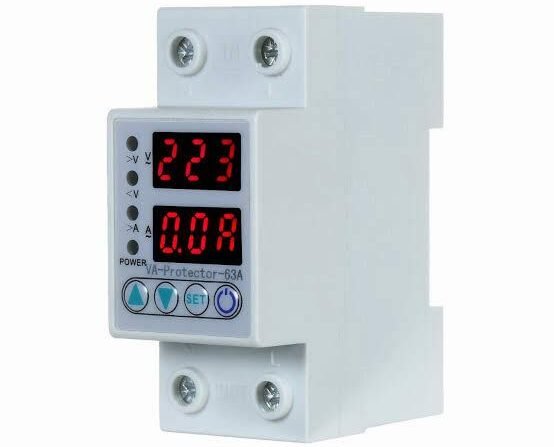
One of the improvements we made during the rebuild was the installation of an Automatic Voltage Switch (AVS).
An AVS monitors the incoming or supplied AC voltage and disconnects the protected circuit when the voltage moves outside its configured safe operating range.
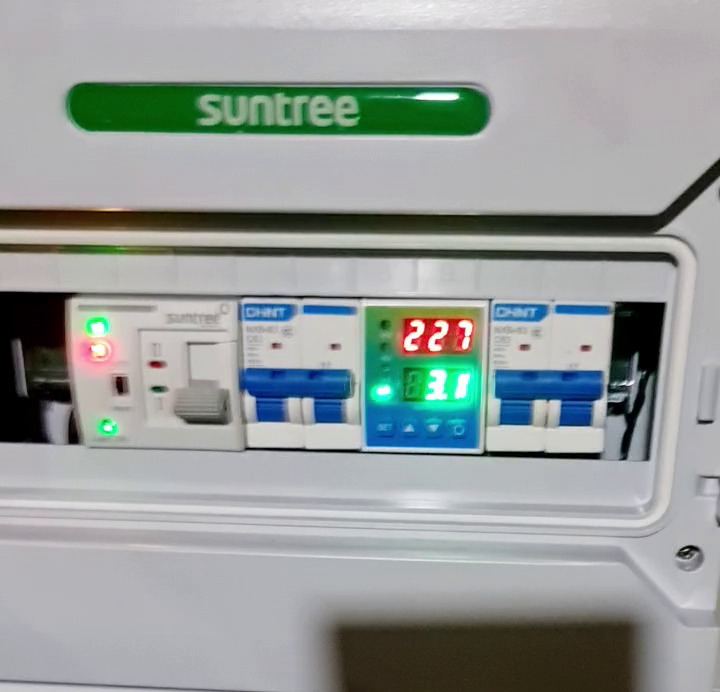
For this project, we installed a DIN rail 2-Pole single phase AVS as part of the upgraded protection system.
The purpose is straightforward:
If the voltage becomes dangerously high or otherwise moves outside the configured operating window, the AVS can disconnect the load instead of allowing abnormal voltage to continue reaching sensitive appliances.
That provides another layer of protection between the power source and household equipment.
It is important to understand, however, that an AVS is not a substitute for proper inverter protection, correct system design, surge protection, earthing, circuit protection and professional commissioning.
Protection should be layered.
Why Surge Protection Matters in a Solar Installation
A properly designed solar installation should include appropriate protection on both the DC and AC sides.
Depending on the installation and risk assessment, this can include:
- DC surge protective devices
- AC surge protective devices
- DC isolators
- AC circuit breakers
- Battery protection and isolation
- Earthing and bonding
- Lightning protection where required
- Correctly sized cables
- Appropriate overcurrent protection
- Voltage protection
The exact protection arrangement depends on the system design, equipment and installation conditions.
This is particularly important in Kenya because solar installations can be exposed to electrical transients and lightning-related risks.
Protection devices are not decorative accessories.
They are part of the electrical engineering of the system.
The Complete Solar System Replacement in Kitale
After assessing the damage, we designed a replacement system around the client’s energy requirements and the existing solar generation capacity.
The rebuilt system included:
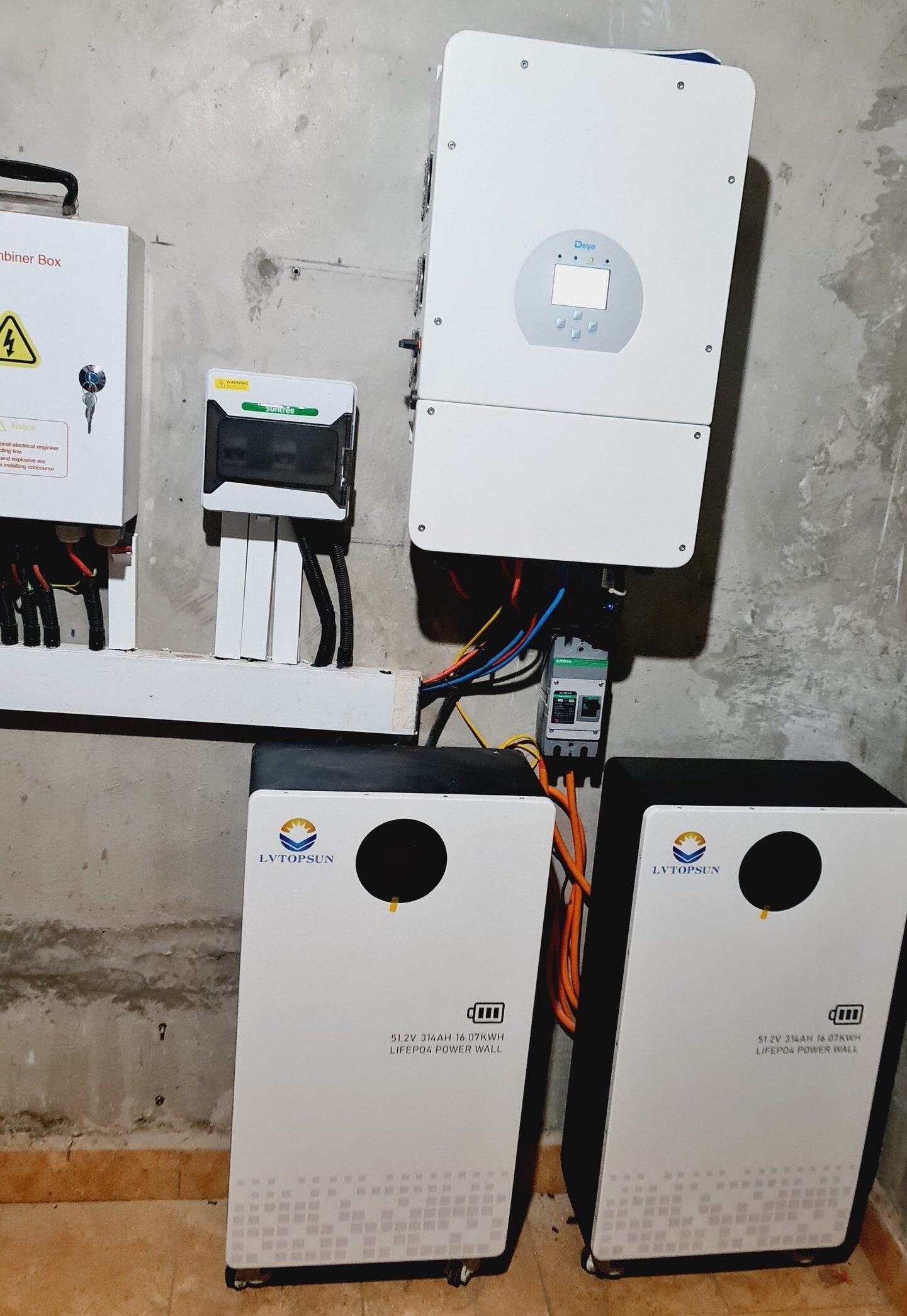
12kW Deye Hybrid Inverter
We installed a Deye SUN-12K-SG01LP1-EU 12kW hybrid inverter.
The inverter provides the central power-conversion and energy-management function for the system.
32.16kWh LiFePO4 Battery Storage
The new battery bank consists of:
2 × LVTopsun LVTS-512314-G3 LiFePO4 batteries
Together, the batteries provide approximately 32.16 kWh of nominal storage capacity.
Moving from the damaged battery bank to a modern lithium iron phosphate storage system provides a substantially different energy-storage platform.
The battery management system also provides electronic monitoring and protection functions appropriate to the battery technology.
15.04kWp Solar Array
The rebuilt solar system contains:
24 existing Jinko 420W solar panels + 8 additional Jinko 620W panels
That gives:
(24 × 420) + 8 x 620W = 15.04kWp
What the New System Achieved
After commissioning, the system was producing approximately 55.6 kWh per day under the observed operating conditions.
The battery bank was reaching 100% state of charge by around 11:00 a.m. during the monitoring period.
Most importantly, the family reported no unplanned power losses after commissioning.
The system was no longer simply “working.”
It had been rebuilt with a stronger emphasis on:
- Correct system sizing
- Battery storage
- Electrical protection
- Monitoring
- Safe isolation
- Surge protection
- Proper commissioning
- Documentation
That is the difference between replacing a broken component and properly restoring a solar power system.
What Solar Owners in Kenya Should Check Today
If you already have a solar installation, you do not need to wait until something fails.
Ask your installer to inspect the following.
1. Does Your System Have Appropriate Voltage Protection?
Ask your installer what protection is installed between the inverter and your household loads.
If an AVS is appropriate for your installation, ask them to explain its configuration and purpose.
2. Do you Have AC and DC Surge Protection?
Ask to see the surge protection devices.
If your system has visual status indicators, check whether they show a healthy condition.
Do not attempt electrical work yourself if you are not qualified.
3. When Were Your Batteries Last Tested?
If you have a multi-battery system, ask whether the batteries have ever been tested individually.
A battery bank should not be judged solely from the voltage displayed on an inverter.
4. Do you Have Your Commissioning Documentation?
A professionally installed solar system should have appropriate documentation.
In Kenya, EPRA provides guidance and documentation relating to Solar PV works, including commencement and completion certificate processes.
Ask your installer what documentation applies to your installation and keep it safely.
5. Do you Know Which Appliances Your Inverter can Safely Operate?
Make sure your installer knows the appliances you intend to use.
Tell them if you operate:
- Water pumps
- Welders
- Grinders
- Compressors
- Workshop equipment
- Large refrigerators
- Freezers
- Electric motors
- Power tools
A solar system should be designed around the real loads, not an estimated list that leaves out the largest equipment.
Can you use Power Tools With a Solar Inverter?
The answer is:
Sometimes, but do not assume so.
A suitably sized inverter can operate certain motor-driven appliances and power tools if the system has been correctly designed for their starting and running characteristics.
The problem is that not all inverters, batteries or installations are equal.
Before connecting a heavy power tool, your installer should check:
- The tool’s rated power.
- Its starting current.
- The inverter’s continuous output rating.
- The inverter’s surge rating.
- The battery bank’s ability to supply the required current.
- Cable sizing.
- Protection devices.
- The effect of the load on other appliances.
- Whether the inverter manufacturer permits the intended load.
If the system was not designed for workshop equipment, use an appropriate alternative power source rather than experimenting with an expensive solar installation.
What this Kitale Solar System Repair in Kenya Teaches us
The biggest lesson from this project is not simply that an angle grinder can damage a solar system.
The bigger lesson is that solar systems need proper engineering, protection, monitoring and maintenance.
The solar panels survived.
The inverter did not.
Several batteries subsequently became unusable.
Household appliances were damaged.
A relatively small electrical incident therefore became a major system replacement.
This is why the cheapest solar quotation is not necessarily the cheapest solar system.
The real cost of a solar installation includes:
- Equipment quality
- Correct system sizing
- Protection
- Installation workmanship
- Commissioning
- Documentation
- Maintenance
- After-sales support
A professional solar installer should be able to explain all of these.
How Aretha Solar Power Solutions can Help
At Aretha Solar Power Solutions, we work with residential and commercial clients across Kenya to design, install, troubleshoot and maintain solar power systems.
Our services include:
- Solar system design and sizing
- Solar panel installation
- Hybrid inverter systems
- Battery storage systems
- Solar system troubleshooting
- Battery testing
- Electrical protection upgrades
- Site surveys
- Load profiling
- System commissioning
- Solar system maintenance
- Backup power solutions
- After-sales support
We are based in Eldoret and serve clients across Kenya.
If your solar system is cutting off, your inverter is showing faults, your batteries are not holding charge, or you are simply unsure whether your installation is properly protected, it is better to investigate the problem early.
A small diagnostic visit can prevent a much larger equipment failure.
Frequently Asked Questions About Solar Inverter Problems
Can an Angle Grinder Damage a Solar Inverter?
Yes. An angle grinder contains an electric motor and can present a demanding load to an inverter. Starting current, motor characteristics, overloads and electrical transients can all affect an inverter. Whether a particular grinder will damage a particular inverter depends on the equipment and installation.
Why did the Solar Inverter Fail While the Panels Survived?
The panels and inverter perform very different functions.
Solar panels generate DC electricity and are designed to operate within specified voltage and current ranges. The inverter contains sophisticated electronic components that convert DC electricity into AC power and control the output.
An electrical fault can therefore damage the inverter without necessarily damaging the solar panels.
How do I Know if my Solar Batteries are Damaged?
Individual battery testing is important.
A technician can measure battery voltage, assess charging behaviour and, where appropriate, perform additional capacity or performance tests.
A single bank-voltage reading is not enough to determine the condition of every battery in a multi-battery system.
Should I Replace Only the Dead Batteries?
Not always.
If several batteries have failed and the remaining batteries have also been deeply discharged or heavily aged, mixing new batteries with degraded ones can lead to poor performance and imbalance.
The correct decision depends on battery chemistry, age, configuration, condition and test results.
What is an Automatic Voltage Switch?
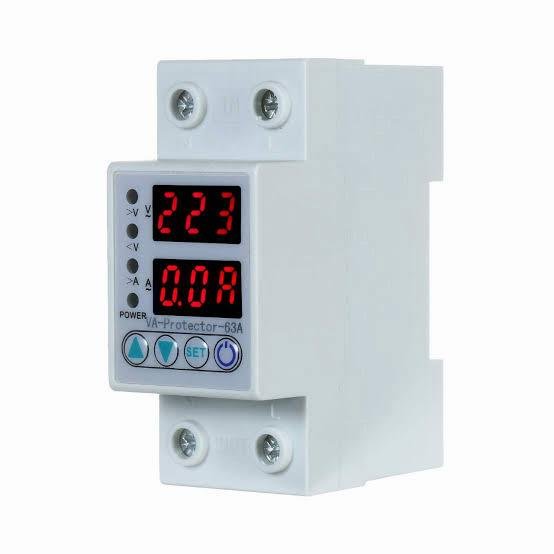
An Automatic Voltage Switch monitors AC voltage and disconnects the protected load when voltage moves outside its configured operating range.
It can provide an additional layer of protection for sensitive household equipment.
It should be installed as part of a properly designed electrical protection system rather than treated as a replacement for other protection measures.
How Often Should Solar Batteries be Checked?
The appropriate maintenance interval depends on the battery technology, system design, usage and manufacturer requirements.
However, if your system is experiencing unusual battery behaviour, repeated low-voltage shutdowns, reduced backup time or inconsistent charging, arrange an inspection rather than waiting for complete failure.
Is Your Solar System Properly Protected?
The Kitale installation is a reminder that solar power systems deserve the same level of engineering attention as any other electrical installation.
Your inverter is valuable.
Also, your batteries are valuable.
And finally, your appliances are valuable.
And more importantly, your family’s safety matters.
Do not wait until an inverter fails or your batteries collapse before asking whether your system has adequate protection.
Aretha Solar Power Solutions provides solar system design, installation, troubleshooting, battery testing, protection upgrades and maintenance across Kenya.
Based in Eldoret. Serving clients across Kenya.
Need your solar system inspected or repaired?
Call or WhatsApp +254 140 630 915 for a consultation.
Related Resources
If you are researching solar system maintenance, also see:
- How to Check Your Solar Batteries
- Why Your Solar System Cuts Off at Night
- Why Your Solar Inverter Keeps Going Into Fault
- What a Solar Commissioning Certificate Means
- How to Choose the Right Solar Battery in Kenya
- How to Size a Solar System for Your Home or Business
For information about Kenya’s Solar PV regulatory guidance and completion documentation, consult the Energy and Petroleum Regulatory Authority (EPRA).
Final Takeaway on This Solar System Repair in Kenya
The Kitale solar system did not fail because solar power is unreliable.
It failed because an electrical system experienced a damaging event and did not have enough protection to prevent the consequences from spreading through the installation.
The investigation showed why professional solar installation matters.
We did not simply replace the inverter.
Secondly, we tested the solar array.
Thridly, we tested all 16 batteries individually.
And then we identified severely damaged batteries.
Next, we assessed the battery-bank configuration.
We replaced the unsuitable storage bank.
And so we then installed a new hybrid inverter.
We upgraded the protection system.
Finally, we commissioned the rebuilt installation.
And we documented the system so the client could understand what had been installed.
That is how a solar system repair should be approached.
If you already have a solar system in Kenya, don’t wait for a failure before checking whether it is properly protected.
A professional inspection today could save you from replacing an inverter, battery bank and household appliances tomorrow.
Aretha Solar Power Solutions — reliable solar power, properly designed and professionally installed.
Eldoret | Serving Kenya
Call/WhatsApp: +254 140 630 915