

How to test solar battery health check in Kenya, identify failing batteries, understand voltage readings, and know when to call a professional
Your solar batteries could be failing right now — and you might not know it until your solar system starts shutting down at night.
That is exactly what happened in a solar installation we inspected in Kitale, Kenya.
The system had a 16-battery bank. Five batteries were already severely failed, while the remaining eleven had suffered significant damage. The homeowner had not realised how serious the problem had become.
This is an important lesson for anyone using solar power in Kenya:
A solar system can have working solar panels and a working inverter and still perform badly because of unhealthy batteries.
The good news is that you do not always need expensive diagnostic equipment to perform an initial battery health check.
For many conventional 12V lead-acid solar batteries, a basic digital multimeter can give you an important first indication of whether a battery deserves further investigation.
In this Episode 2 of our four-part solar battery troubleshooting series, we will show you how to check your batteries, what the voltage readings can tell you, why one bad battery can affect an entire battery bank, and when you should stop testing and call a qualified solar technician.
Important: Voltage testing is a useful first diagnostic step, but voltage alone cannot determine the complete health, capacity, internal resistance or remaining cycle life of a battery. A professional battery assessment may require additional testing.
What You Will Learn in This Guide
By the end of this article on solar battery health check in Kenya and beyond, you will understand:
- How to check a solar battery with a digital multimeter
- How long to let a battery rest before measuring its voltage
- What different 12V battery voltage readings can indicate
- Why batteries in the same bank should be tested individually
- Why one failed battery can affect other batteries
- What symptoms can indicate a failing solar battery
- The difference between checking GEL/AGM batteries and LiFePO4 batteries
- When a battery may need further testing rather than immediate replacement
- When you should call a solar technician
- Why mixing significantly different batteries in the same bank can cause problems
- How regular battery inspections can help protect your solar investment
Why Checking Your Solar Batteries Matters
Many solar users focus on their panels and inverter.
They ask:
“Are my panels producing enough power?”
Or:
“Is my inverter working properly?”
Those are important questions, but the battery bank deserves just as much attention.
In an off-grid or hybrid solar system, the batteries are responsible for storing energy generated during the day so that it can be used when solar production is low or unavailable.
If the battery bank is unhealthy, your system may:
- Shut down earlier than expected at night
- Have significantly reduced backup time
- Show unexpected low-battery alarms
- Charge unusually quickly
- Discharge unusually quickly
- Struggle to run normal household loads
- Show large voltage differences between batteries
- Require increasingly frequent charging
- Appear to have enough battery capacity on paper but deliver much less in practice
The problem is that battery degradation can happen gradually.
You may simply assume that your solar system is “not producing enough,” when the real problem is the storage system.
That is why solar battery testing should be part of routine solar system maintenance in Kenya.
What Happened to the 16-Battery Solar Bank in Kitale?
During our inspection in Kitale, we encountered a battery bank containing 16 batteries.
The condition of the bank demonstrated why testing batteries individually is so important.
Five batteries had failed severely, while the other batteries had also been affected.
The homeowner did not have an obvious warning that several batteries were in serious trouble.
This is one of the most dangerous characteristics of a poorly maintained battery bank:
The system can continue operating even while individual batteries are deteriorating.
A solar inverter may still turn on.
The solar panels may still generate electricity.
Lights may still work.
The television may still work.
But the battery bank can gradually lose its ability to provide reliable energy at night.
By the time the problem becomes obvious to the homeowner, the damage can be extensive.
What You Need to Check a Solar Battery
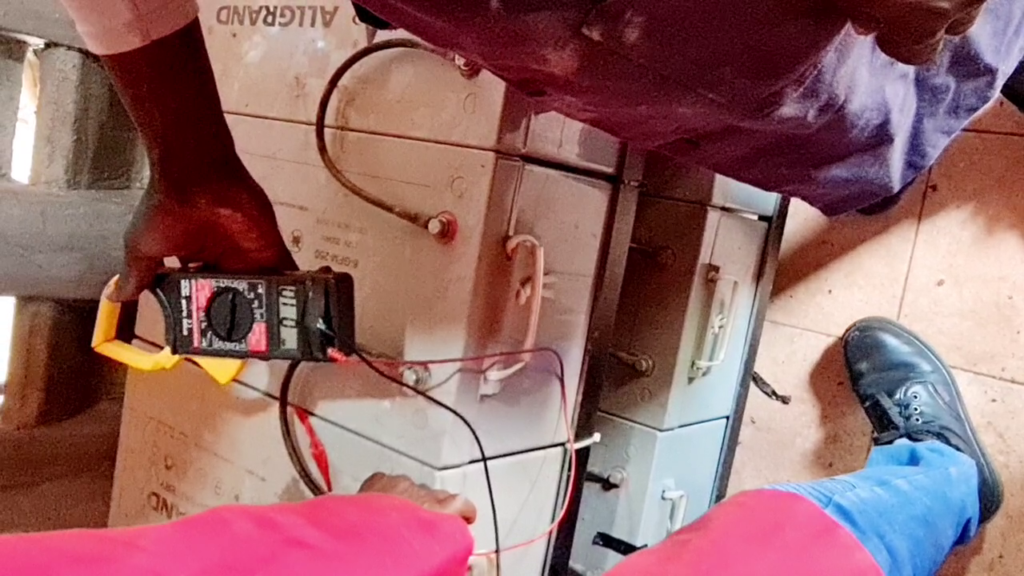
For a basic voltage inspection of a conventional battery, you need:
1. A Digital Multimeter
A basic digital multimeter is sufficient for an initial voltage check.
You can find basic multimeters in Kenya at electrical and hardware shops, although prices vary depending on the model and quality.
Set the meter to DC voltage (V DC).
2. Access to the Battery Terminals
You need to be able to identify the:
- Positive (+) terminal
- Negative (−) terminal
3. A way to Record Your Readings
This is extremely useful when you have multiple batteries.
For example:
| Battery | Resting Voltage | Observation |
|---|---|---|
| Battery 1 | 12.72V | Normal reading |
| Battery 2 | 12.68V | Normal reading |
| Battery 3 | 12.65V | Normal reading |
| Battery 4 | 11.82V | Investigate |
| Battery 5 | 10.94V | Critical reading — professional assessment recommended |
The important thing is not simply to measure one battery.
Measure every battery individually.
Step-by-Step: How to Test a 12V Solar Battery
Step 1: Turn off the System Safely
If you are carrying out a battery voltage and health check in Kenya, follow the manufacturer’s shutdown procedure.
Depending on the installation, this may involve switching off:
- Household loads
- Inverter
- Solar charge controller
- Battery isolator or breaker
If your battery bank contains high DC voltages or you are not familiar with electrical isolation procedures, do not attempt the test yourself.
A 48V battery system, for example, can deliver dangerous current even though each individual battery may be rated at 12V.
Step 2: Allow the Battery to Rest
If possible, allow a lead-acid battery to rest after charging or discharging before taking a resting-voltage measurement.
A short rest period helps reduce the effect of surface charge.
For a basic homeowner inspection, 30 minutes or longer with the battery isolated from charging and loads can provide a more meaningful reading than measuring immediately after charging.
However, resting voltage is still only one diagnostic indicator.
Temperature, battery age, recent load, state of charge and battery chemistry can all influence the reading.
Step 3: Set the Multimeter to DC Voltage
Select the DC voltage setting.
If your multimeter has several voltage ranges, choose an appropriate range for a 12V battery.
Do not accidentally select AC voltage.
Step 4: Connect the Probes Correctly
Place:
Red probe → Positive (+)
Black probe → Negative (−)
The display will show the measured voltage.
If the probes are reversed, many digital multimeters will simply display a negative value. However, always check the polarity carefully.
Step 5: Record the Reading
Write down the voltage.
Then move to the next battery.
Do not assume that because Battery 1 looks healthy, Battery 2, Battery 3 and Battery 4 are also healthy.
This is particularly important when several batteries are connected together.
What Do 12V Solar Battery Voltage Readings Mean?
Voltage readings must always be interpreted according to the battery manufacturer’s specifications, chemistry, temperature and state of charge.
For a conventional 12V GEL or AGM lead-acid battery, a resting voltage around the mid-12V range generally indicates a relatively high state of charge.
As a general diagnostic guide:
Around 12.6–12.8V
This can indicate a well-charged battery at rest.
It does not, by itself, prove that the battery is healthy.
A battery can show a good resting voltage while having severely reduced capacity.
Around 12.0–12.5V
The battery may be partially discharged.
If all batteries in an identical bank show similar readings, the bank may simply require charging.
If one battery is significantly lower than the others, however, it deserves further investigation.
Around 11.0–11.9V
This is a warning zone.
A battery at this voltage after an appropriate rest period is significantly discharged and may indicate a problem, particularly if the rest of the bank is much higher.
Do not immediately assume the battery must be replaced.
It should be charged and tested according to the manufacturer’s specifications.
Below Approximately 11V
This is a serious reading for a conventional 12V lead-acid battery.
The battery may be deeply discharged, damaged or otherwise abnormal.
Professional assessment is recommended.
Very Low Readings
A battery showing an extremely low voltage, especially when the other batteries in the bank are healthy, should be treated as a serious fault condition.
It may have a failed cell, severe sulfation, internal damage or another problem.
Do not use voltage alone to declare a battery “unrecoverable.”
The appropriate action depends on the battery type, manufacturer specifications, condition and results of further testing.
The Most Important Test: Compare Batteries With Each Other
One of the most useful observations in a multi-battery bank is consistency.
Imagine you have eight identical 12V batteries.
Your readings are:
- 12.71V
- 12.69V
- 12.73V
- 12.70V
- 12.68V
- 12.71V
- 12.70V
- 11.62V
The last battery immediately deserves attention.
It is behaving differently from the rest.
This is why recording individual battery readings is so useful.
A single number does not tell the whole story.
The pattern across the battery bank can reveal a problem that would otherwise be missed.
What If One Battery Has a Different Voltage?
When doing a solar battery health check in Kenya, a voltage difference does not automatically mean that the battery has failed.
There are several possible causes.
The battery could be:
- At a different state of charge
- Recently exposed to a different load
- Suffering from internal degradation
- Poorly connected
- Experiencing a terminal or cable problem
- A different age or model
- Affected by temperature
- Developing an internal fault
This is why professional diagnosis looks at more than voltage.
If one battery consistently remains significantly lower than equivalent batteries after charging and resting under comparable conditions, it should be investigated.
Why One Bad Battery Can Affect the Whole Solar Battery Bank
This was one of the major lessons from our Kitale inspection.
When batteries are connected in series or parallel, they do not necessarily behave as completely independent devices.
A weak battery can affect the operating behaviour of the entire bank.
In a parallel configuration, batteries at different voltages can allow current to flow between them. Depending on the battery chemistry, wiring, state of charge and internal resistance, this can result in unwanted circulating or equalising currents.
In a series bank, a weak battery can become the limiting element of the string.
That means you can have several batteries that appear healthy individually but still have a battery bank that performs poorly because one or more units are significantly weaker.
This is why battery-bank design, matching, wiring and maintenance matter just as much as individual battery quality.
A Warning About “Back-Feeding”
The term battery back-feeding is sometimes used to describe unwanted current flowing from healthier batteries toward a weaker or lower-voltage battery.
This can occur under certain battery-bank configurations and conditions.
However, it is important not to treat every battery-bank problem as identical.
The exact behaviour depends on:
- Series versus parallel configuration
- Battery chemistry
- Battery internal resistance
- State of charge
- Battery-management system
- Wiring resistance
- Protection equipment
- Manufacturer design
For this reason, our Kitale case should be understood as a real-world example of a battery-bank failure, not a claim that every failed battery will always drain every healthy battery in exactly the same way.
The practical lesson remains:
Do not leave a severely abnormal battery connected to a bank without investigating the cause.
Can You Mix Old and New Solar Batteries?
This is one of the most important questions we receive.
In general, you should not casually mix significantly different batteries in the same battery bank.
Problems can arise when batteries have different:
- Ages
- Capacities
- Internal resistance
- Manufacturers
- Models
- Chemistries
- States of health
- Charging requirements
An old battery and a new battery may have the same label rating but behave very differently under load and during charging.
When several batteries in an old bank have failed, your solar technician should assess whether replacing only one battery is appropriate.
In some cases, replacing the entire bank is the safer and more technically appropriate solution.
The correct decision depends on the battery architecture and manufacturer’s recommendations.
GEL vs LiFePO4: What Changed in the Kitale System?
In the Kitale installation, after the solar battery health check, the failed GEL battery bank was replaced with LVTopsun LiFePO4 batteries.
This represents a significant change in battery technology.
GEL Batteries
GEL batteries are a type of valve-regulated lead-acid battery.
They have been widely used in solar installations because they are relatively simple, established and require less routine maintenance than flooded lead-acid batteries.
However, their usable energy and cycle life can be significantly lower than modern lithium iron phosphate systems, depending on the specific battery and how it is operated.
Deep and frequent discharge can shorten their service life.
LiFePO4 Batteries
Lithium iron phosphate, commonly called LiFePO4 or LFP, is now widely used in modern energy-storage systems.
A properly designed LiFePO4 system can offer:
- High usable energy
- High cycle life
- Lower routine maintenance
- More efficient energy storage
- Battery-management-system monitoring
- More compact energy storage
- Better performance under suitable operating conditions
However, lithium batteries are not automatically “better” simply because they are lithium.
Correct system design is essential.
The battery must be compatible with the inverter, charging parameters, protection equipment, communication protocol and installation environment.
Why Battery Management Systems Matter With LiFePO4
A modern LiFePO4 battery normally incorporates a Battery Management System (BMS).
The BMS monitors and protects the battery according to the manufacturer’s design.
Depending on the battery, it may monitor parameters such as:
- Cell voltage
- Battery voltage
- Temperature
- Current
- State of charge
- Charging conditions
- Discharging conditions
Some systems can communicate with compatible inverters using protocols such as CAN or RS485.
That communication can allow the inverter and battery to exchange information about charging, discharging and state of charge.
But remember:
A BMS does not eliminate the need for correct system design.
The inverter, battery, cables, breakers, fuses, communication settings and charging parameters all need to be compatible.
Why Lithium Battery Voltage Is Different
Do not use the same voltage table for every battery chemistry.
A 51.2V LiFePO4 battery is nominally a different system from a 12V GEL battery.
For lithium batteries, state of charge is also not always accurately determined from voltage alone because the voltage curve can remain relatively flat across a substantial portion of the battery’s usable range.
For that reason, if your LiFePO4 battery has a BMS, inverter display or monitoring application, use the manufacturer’s recommended monitoring method.
Finally, for an LVTopsun or other specific battery model, always follow its technical documentation rather than applying a generic internet voltage chart.
Other Signs Your Solar Battery May Be Failing
When dong a solar battery health check in Kenya and beyond, note that voltage testing is only one part of battery diagnosis.
Watch for these warning signs:
1. Your Solar System Shuts Down Early at Night
If your system used to run through the night but now shuts down after only a few hours, the battery bank may have lost usable capacity.
However, increased household consumption or reduced solar charging can cause the same symptom.
2. The Battery Voltage Collapses Under Load
A battery may show a reasonable resting voltage but drop dramatically when a load is applied.
That can indicate reduced battery capacity or increased internal resistance.
This requires a proper load or capacity assessment rather than simply replacing the battery based on one voltage reading.
3. One Battery Behaves Differently From the Rest
If identical batteries in the same bank have similar conditions but one consistently shows abnormal voltage or behaviour, investigate it.
4. The Batteries Become Unusually Warm
Unexpected heating during charging or discharging is a warning sign.
Do not ignore excessive temperature, swelling, leaking, unusual smell or visible physical damage.
Disconnecting equipment should only be done if it can be done safely according to the manufacturer’s procedures.
5. Backup Time Keeps Getting Shorter
This is one of the most common symptoms reported by solar users.
A battery bank may still reach a seemingly normal voltage while its actual usable capacity has deteriorated.
When Should You Call a Solar Technician After a Solar Battery Health Check?
Contact a qualified solar professional if:
- One battery is significantly different from the others
- A battery remains abnormally low after appropriate charging
- Your system repeatedly shuts down at night
- Battery backup time has fallen substantially
- Batteries become unusually hot
- You notice swelling, leakage, corrosion or physical damage
- The inverter reports repeated battery faults
- A lithium battery’s BMS reports an error
- You suspect a charging problem
- Your battery bank has not been inspected for an extended period
- You are unsure how to safely isolate the battery bank
And most importantly:
Do not open a battery or attempt internal repairs yourself.
Batteries can contain significant stored energy and, depending on the chemistry, can present electrical, chemical and thermal hazards.
How Often Should the Health of Solar Batteries Be Checked in Kenya?
There is no single inspection interval that is correct for every system.
It depends on:
- Battery chemistry
- Battery age
- System design
- Operating temperature
- Daily depth of discharge
- Charging conditions
- Installation environment
- Manufacturer recommendations
- Whether the system is residential or commercial
For a solar installation that is important to your home or business, periodic professional inspection is a sensible maintenance practice.
A technician can inspect more than just voltage.
They can assess:
- Battery connections
- Cable condition
- Terminal condition
- Protection devices
- Charging voltage
- Inverter settings
- Battery-bank configuration
- Battery temperatures
- BMS information
- System performance
- Load profile
- Solar production
- Historical alarms
This gives you a much clearer picture of the health of the entire solar system.
The Biggest Mistake: Waiting Until the Batteries Completely Fail
The most expensive time to discover a battery problem is often when the entire system has already stopped working.
A simple inspection can reveal that one battery is behaving differently.
That gives you an opportunity to investigate before the problem develops into a larger system failure.
For businesses, this can be especially important.
A failed backup system can interrupt:
- Point-of-sale systems
- CCTV
- Internet equipment
- Computers
- Refrigeration
- Security systems
- Lighting
- Communications equipment
For homes, it can mean losing power during the night when you need it most.
Battery maintenance is not just about protecting batteries. It is about protecting the reliability of your entire solar investment.
What We Learned From the Kitale Battery Failure
The Kitale installation reinforced several important lessons.
Lesson 1: Do not Judge the Battery Bank From the Inverter Display Alone.
The inverter may show the total battery voltage while one or more individual batteries are deteriorating.
Lesson 2: Test Batteries Individually.
A multi-battery bank should be assessed battery by battery when troubleshooting.
Lesson 3: Look for Patterns.
A single abnormal reading among otherwise similar batteries deserves attention.
Lesson 4: Voltage is a Screening Tool, not a Complete Health Test.
A battery can show a normal voltage and still have poor capacity.
Lesson 5: Do not Ignore Unusual System Behaviour.
Shorter backup time, low-voltage alarms and unexpected shutdowns are clues.
Lesson 6: Correct Battery Replacement Matters.
Replacing batteries without considering the complete bank configuration can create another problem.
Lesson 7: Professional Assessment can Save Money.
Finally, when a professional does a solar a battery health check in Kenya, finding a developing problem early may prevent damage to other equipment and reduce unexpected downtime.
Need a Solar Battery Health Check in Kenya?
If you are experiencing shorter backup times, repeated low-battery alarms, unexplained solar-system shutdowns or inconsistent battery readings, Aretha Solar Power Solutions Limited can help assess your system.
We provide solar system services including:
- Solar battery health checks
- Solar system inspections
- Battery replacement
- Solar system troubleshooting
- Load profiling
- Solar system design and sizing
- Hybrid inverter systems
- Backup power solutions
- Solar installation and commissioning
- Maintenance and after-sales support
We work with homeowners, businesses, institutions and other organisations looking for reliable solar power solutions in Kenya.
Whether your system uses GEL, AGM or LiFePO4 batteries, the first step is understanding what is actually happening inside the system.
Don’t wait until your solar system stops working completely.
If you suspect your batteries are failing, contact Aretha Solar Power Solutions Limited for a professional assessment.
Call or WhatsApp: +254 140 630 915
Need a solar battery health check? Contact Aretha Solar today for a consultation.
Frequently Asked Questions About Solar Battery Testing in Kenya
How Do I Know if My Solar Battery is Failing?
Common signs during a solar battery health check include reduced backup time, low-voltage alarms, unusual voltage differences between batteries, rapid voltage drops under load, repeated system shutdowns and abnormal battery temperature. A multimeter can provide an initial voltage check, but a professional assessment is needed to determine actual battery capacity and overall health.
Can I Test a Solar Battery with a Multimeter?
Yes. A digital multimeter can be used to measure the battery’s DC voltage. For a meaningful resting-voltage measurement, isolate the battery safely and allow it to rest after charging or discharging. Voltage alone, however, does not provide a complete battery health assessment.
What Voltage Should a 12V Solar Battery Have?
A fully charged 12V lead-acid battery may typically show a resting voltage in the mid-12V range, but the exact value depends on battery chemistry, temperature, state of charge and manufacturer specifications. Always use the manufacturer’s voltage chart where available.
Is 11V Bad for a 12V Solar Battery?
An 11V reading after an appropriate rest period is a serious warning for a conventional 12V lead-acid battery. It may be deeply discharged or damaged. The battery should be properly assessed rather than automatically declared failed based on voltage alone.
Can a Solar Battery Show 12.7V and Still be Bad?
Yes.
A battery can show a normal resting voltage while having significantly reduced capacity. This is why battery capacity, load behaviour and other diagnostic measurements can be necessary.
Should I Replace one Solar Battery or the Whole Battery Bank?
It depends on the system design, battery age, battery chemistry, condition of the remaining batteries and manufacturer’s recommendations. In an older bank with multiple degraded batteries, replacing only one battery may not be the best solution.
Can I Mix Old and New Solar batteries?
It is generally not advisable to mix substantially different batteries without confirming that the configuration is approved by the battery manufacturer and appropriate for the system. Differences in age, capacity and internal resistance can cause uneven operation.
Are LiFePO4 Batteries Better Than GEL Batteries?
LiFePO4 batteries can offer higher usable capacity, longer cycle life and sophisticated battery-management features compared with many GEL batteries. However, suitability depends on the application, system design, budget, inverter compatibility and installation requirements.
How Long do Solar Batteries Last in Kenya?
Battery life varies considerably. Operating temperature, depth of discharge, charging practices, battery quality, maintenance and usage patterns all affect service life. A manufacturer’s cycle-life specification should not be interpreted as a guaranteed number of years in every installation.
Why Does my Solar Battery Die at Night?
Possible causes include insufficient battery capacity, battery degradation, excessive night-time loads, inadequate daytime charging, incorrect inverter settings, poor connections or a faulty battery. A proper system assessment should consider both the battery and the load profile.
Can a Bad Solar Battery Damage Other Batteries?
A badly matched or failed battery can affect the behaviour of a battery bank, particularly when batteries are connected together. The exact effect depends on the configuration and battery chemistry. A severely abnormal battery should be investigated rather than left connected indefinitely.
How Often Should I Service my Solar System?
The appropriate interval depends on the system and manufacturer recommendations. Regular inspections are particularly important for systems that provide critical backup power. Professional maintenance should include more than just checking battery voltage.
Episode 2 of Our Solar Battery Troubleshooting Series
This article is Episode 2 of our four-part solar battery troubleshooting series.
If you are following the series, and interested in solar battery health check in Kenya, continue with the other episodes to learn how to identify common battery and solar-system problems before they become expensive failures.
Episode 1: We found a Solar System That Nearly Burned Down a House
Episode 2: 16 Dead Batteries – Here’s What Killed Them — you are here
Episode 3: Episode Three Coming Soon
Episode 4: What to do when your solar system cuts off at night
You can also watch the practical demonstrations on the Aretha Solar Power Solutions YouTube channel.
Final Takeaway on Solar Battery Health Check in Kenya
Your solar battery bank is one of the most important components of your solar power system.
And you do not need expensive equipment to begin checking it.
A basic digital multimeter can help you identify unusual voltage readings and determine whether a battery requires further investigation.
But remember the most important rule:
A voltage reading is an indication — not a complete battery health diagnosis.
If one battery is substantially different from the others, your backup time is falling, your inverter is reporting battery faults, or your batteries are showing signs of physical or thermal damage, do not wait until the entire system fails.
Get the system assessed.
The Kitale 16-battery case is a good reminder of why early diagnosis matters. Five failed batteries were eventually identified, and the condition of the wider battery bank demonstrated how one problem can become a much larger system issue when it is not detected early.
At Aretha Solar Power Solutions Limited, our goal is not simply to install solar systems.
We want those systems to remain reliable, safe and useful for the people and businesses depending on them.
If you think your solar batteries are failing, contact Aretha Solar Power Solutions Limited today.
Call or WhatsApp: +254 140 630 915
Serving solar customers across Kenya.